Document ingestion
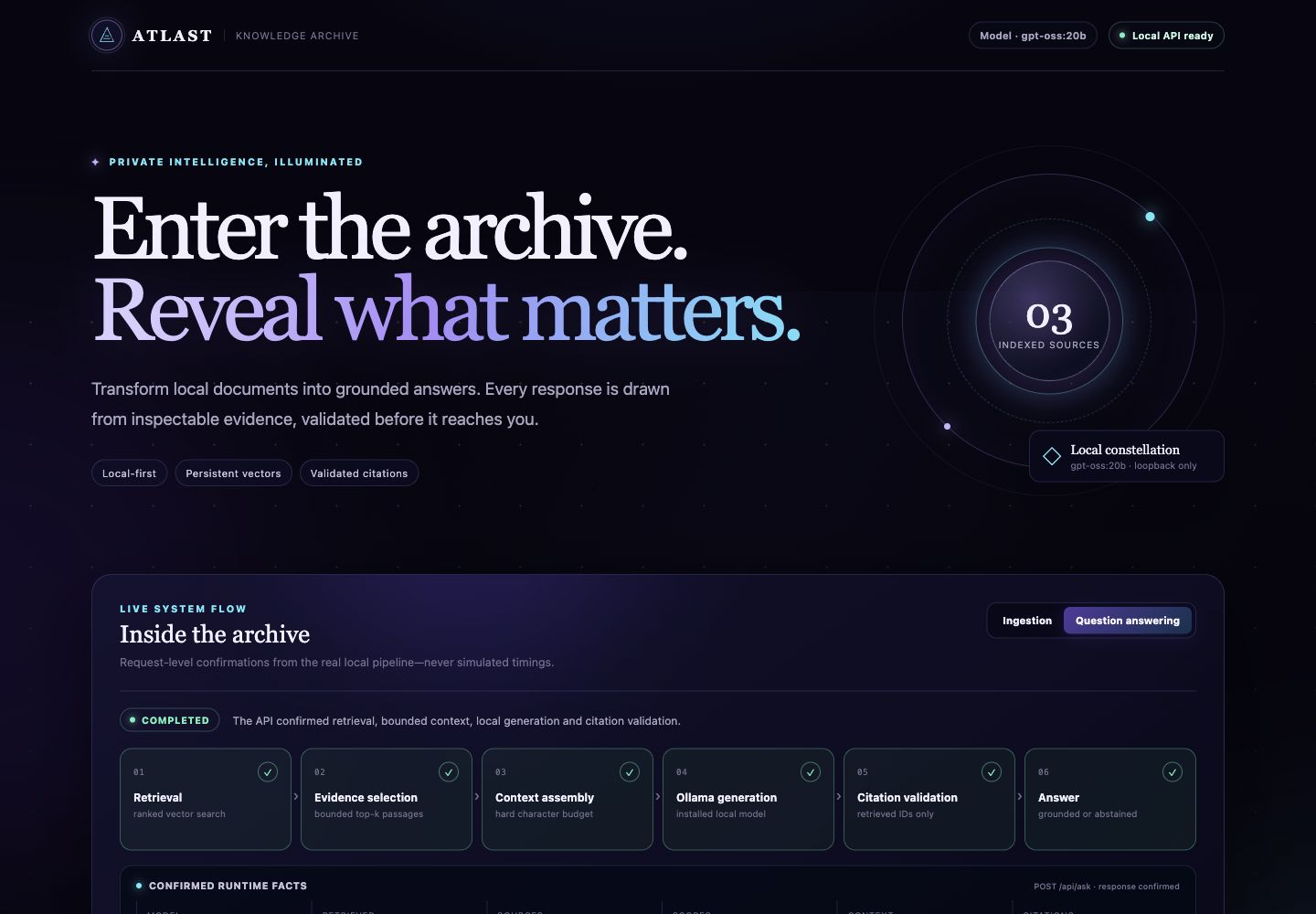
- 01Validate upload
- 02Extract text
- 03Chunk deterministically
- 04Create embeddings
- 05Index in Qdrant

RAG DOCUMENT INTELLIGENCE / LOCAL-FIRST MVP
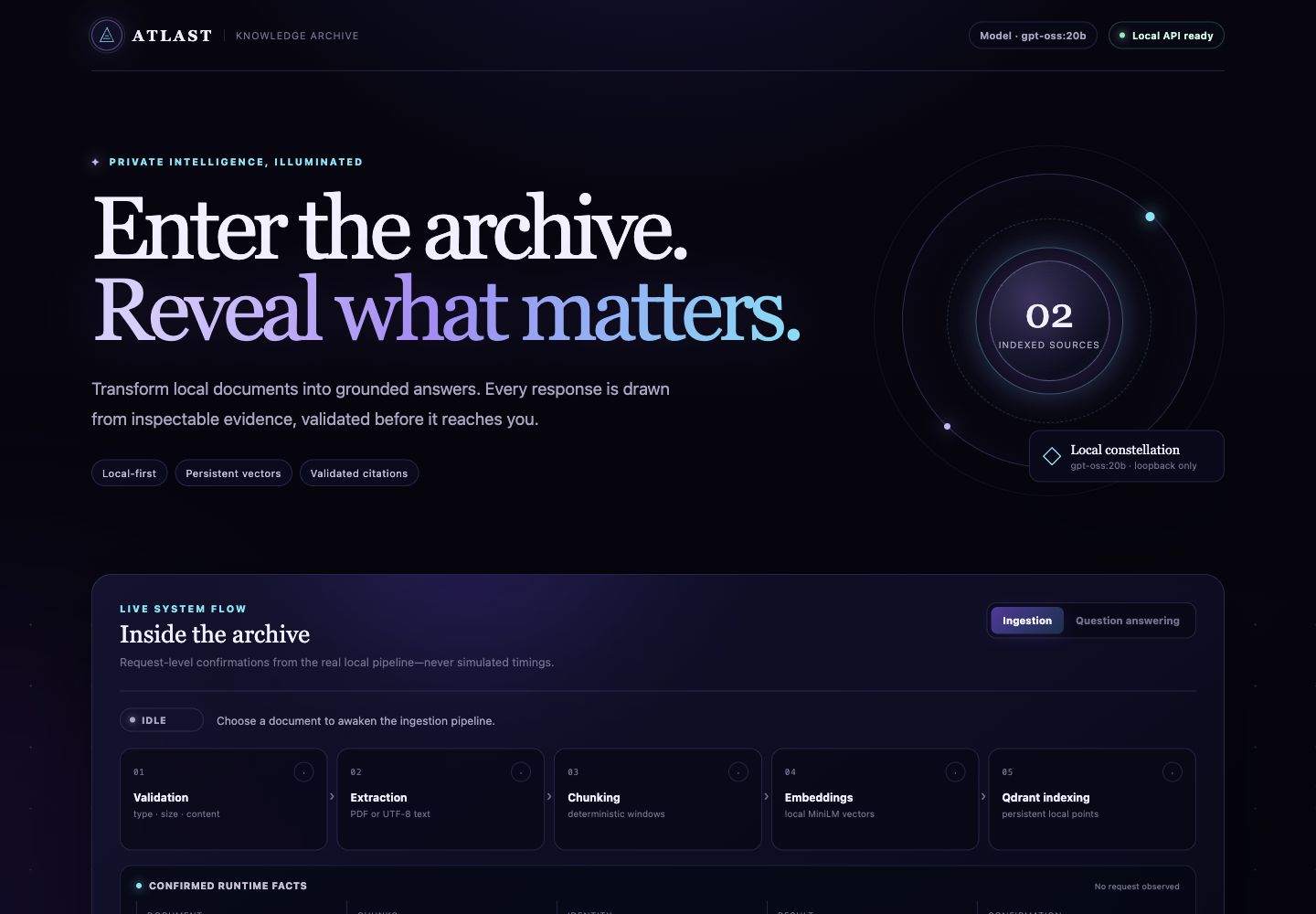
ATLAST ingests local PDF and TXT files, retrieves the most relevant passages, asks a local Ollama model to answer from that evidence, and exposes only citations validated against the retrieved sources.
01 / PROBLEM & VALUE
Operational knowledge is trapped across PDFs and text files. Keyword search finds strings, but rarely gives a concise answer with enough context to trust it.
Build a deterministic local index, retrieve passages by semantic similarity, bound the evidence sent to a local model, then validate every returned citation ID.
A usable document-intelligence workflow whose source passages, document titles and page or section metadata stay inspectable from answer to archive.
02 / LIVE SYSTEM FLOW
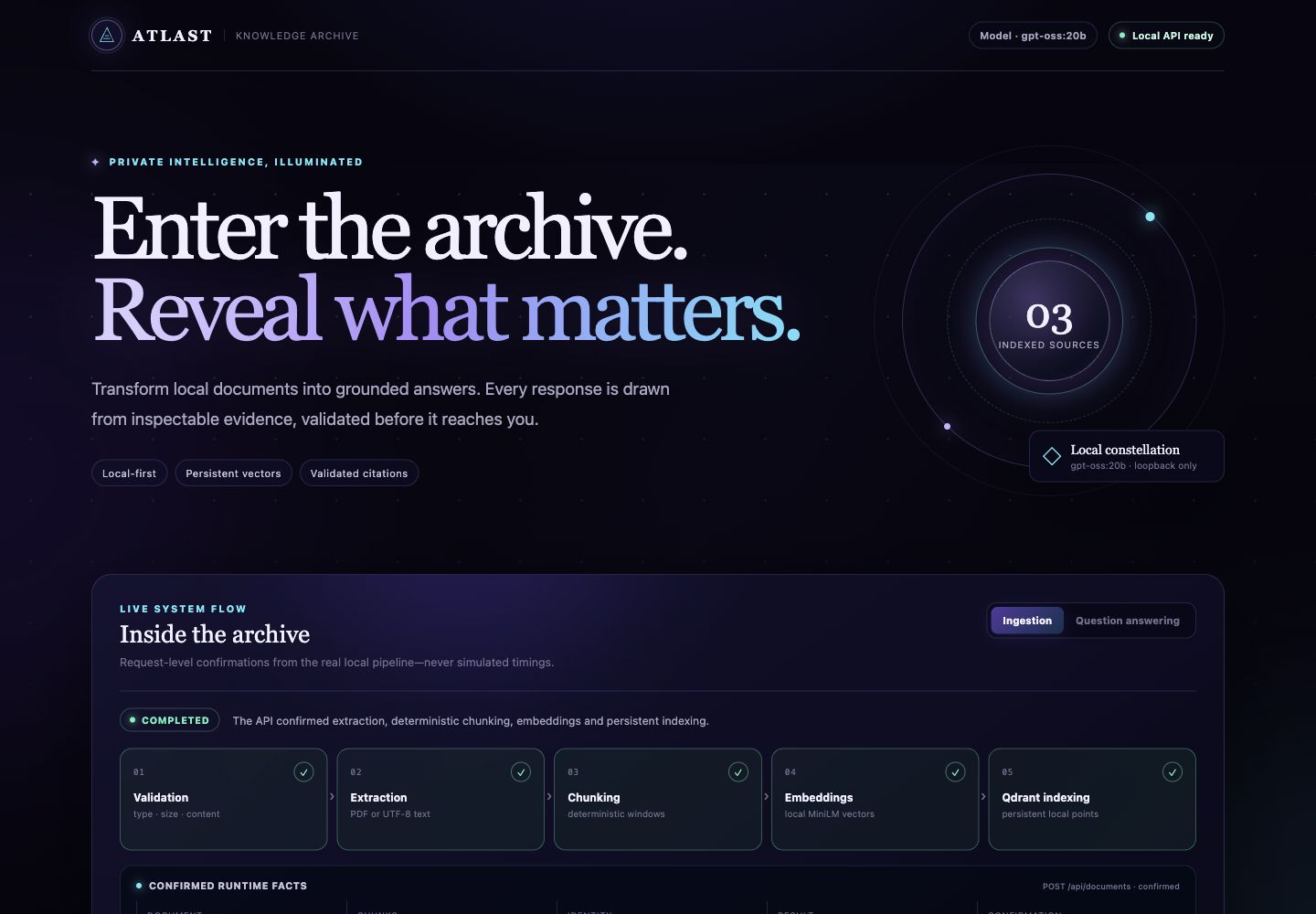
The interface confirms request-level stages from real API outcomes and returned metadata. It does not claim streamed, real-time backend events or invented timings.
03 / WORKING FEATURES
Extract text and retain stable document identity, filename, page or section metadata where available.
Content hashes detect duplicates; deterministic chunks and lightweight Sentence Transformers embeddings feed persistent Qdrant local storage.
Document text is treated as untrusted data. The prompt constrains generation to retrieved evidence and unsupported questions can return an insufficient-evidence response.
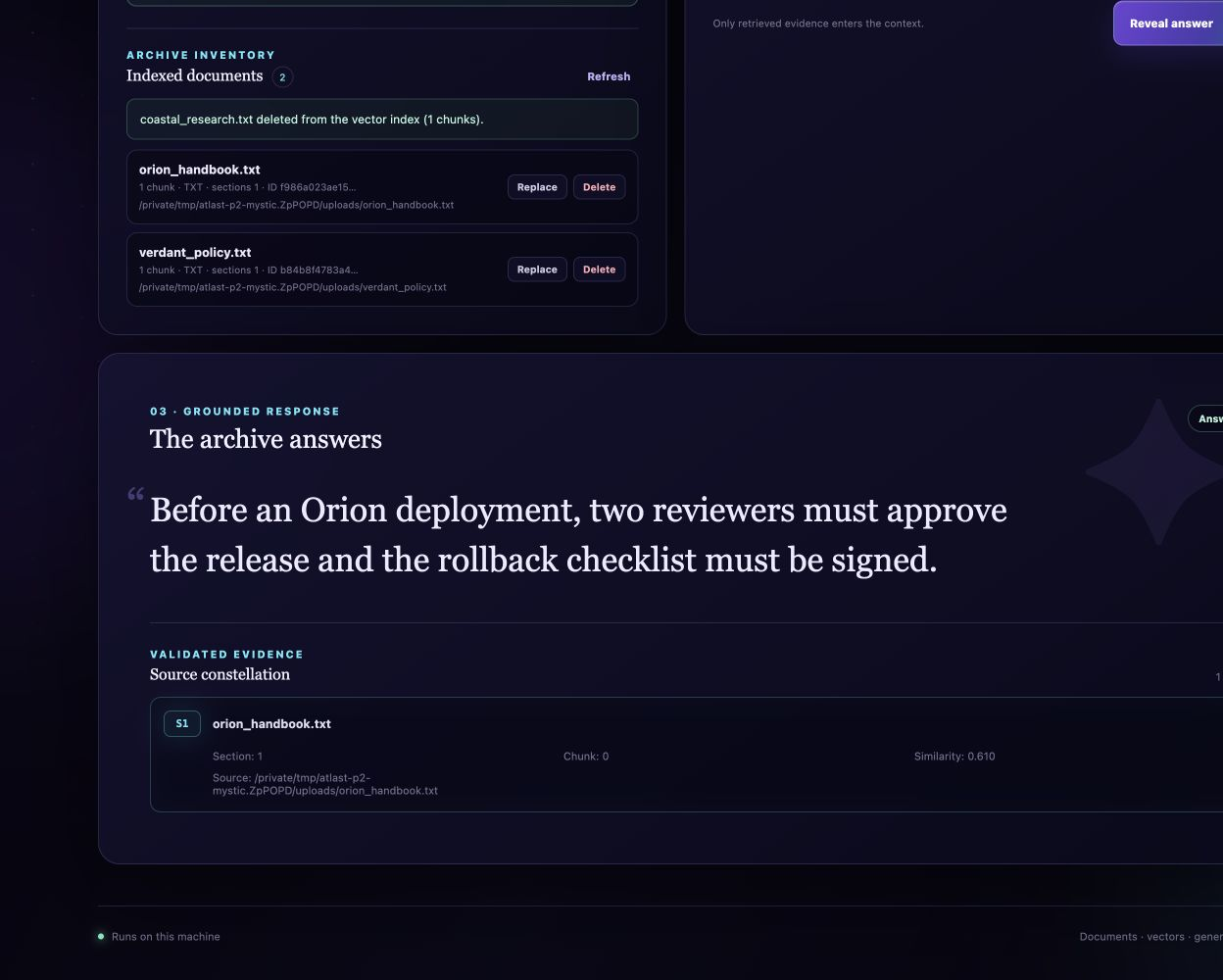
Citation IDs are accepted only when they match retrieved passages, with title and page or section metadata returned alongside them.
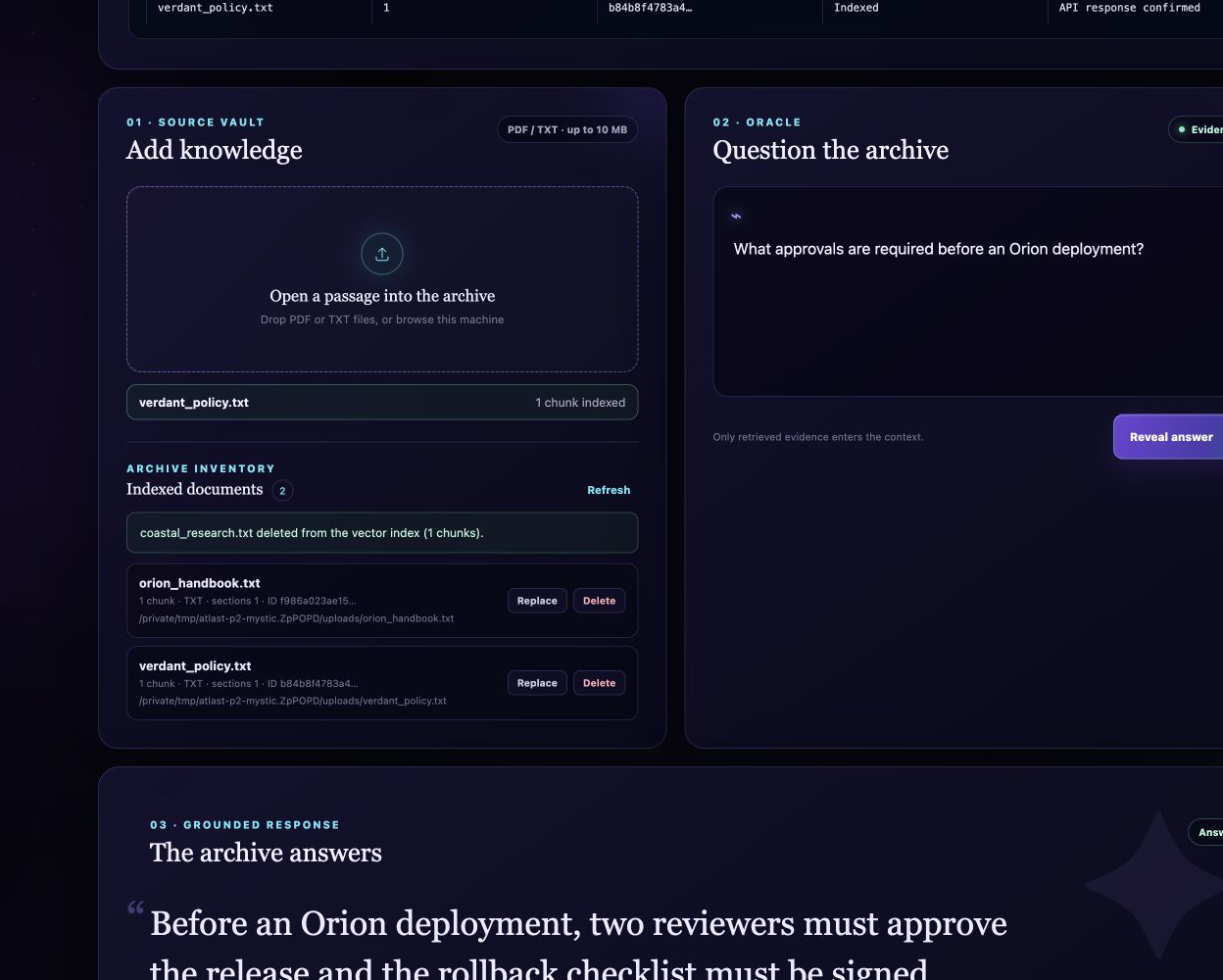
List, replace and delete one document at a time. Replacement keeps the existing document until the new upload indexes successfully.
The same ingestion, retrieval and QA services power command-line workflows, FastAPI endpoints and the responsive browser interface.
04 / ARCHITECTURE
A buildless web interface calls a loopback FastAPI application. The backend owns validation, extraction, embeddings, Qdrant persistence, bounded retrieval context, Ollama generation and citation validation.
05 / RELEASE VERIFICATION
A6 release verification used the packaged wheel and a real installed Ollama gpt-oss:20b model. The retrieval benchmark contains six labeled, answerable questions in a small synthetic corpus.
These perfect synthetic retrieval scores do not establish general RAG accuracy, answer quality or performance on real organizational documents.
06 / REAL SCREENS
All five screens come from the local application using synthetic documents. There is no hosted interactive demo.
07 / LOCAL EXECUTION
ATLAST is local software, not a public API. It requires Python 3.12, uv and a locally installed Ollama model. The default embedding model is downloaded on first use and cached locally; ATLAST never downloads an Ollama model automatically.
git clone https://github.com/fadel-santiago/atlast.git
cd atlast
uv python install 3.12
uv sync --frozen
uv run --frozen atlast --db .atlast/qdrant ingest examples/sample.txt
uv run --frozen atlast --db .atlast/qdrant serve --ollama-model gpt-oss:20b --port 8000
08 / LIMITATIONS